Specialist intelligence
Start with one defined imaging task and a model built for that responsibility.

A focused vision for the next generation of imaging intelligence.
Specialist models. Dedicated computation. One connected workstation. Explore how Aetheris plans to move selected inference workloads toward a custom accelerator architecture.
Research & engineering concept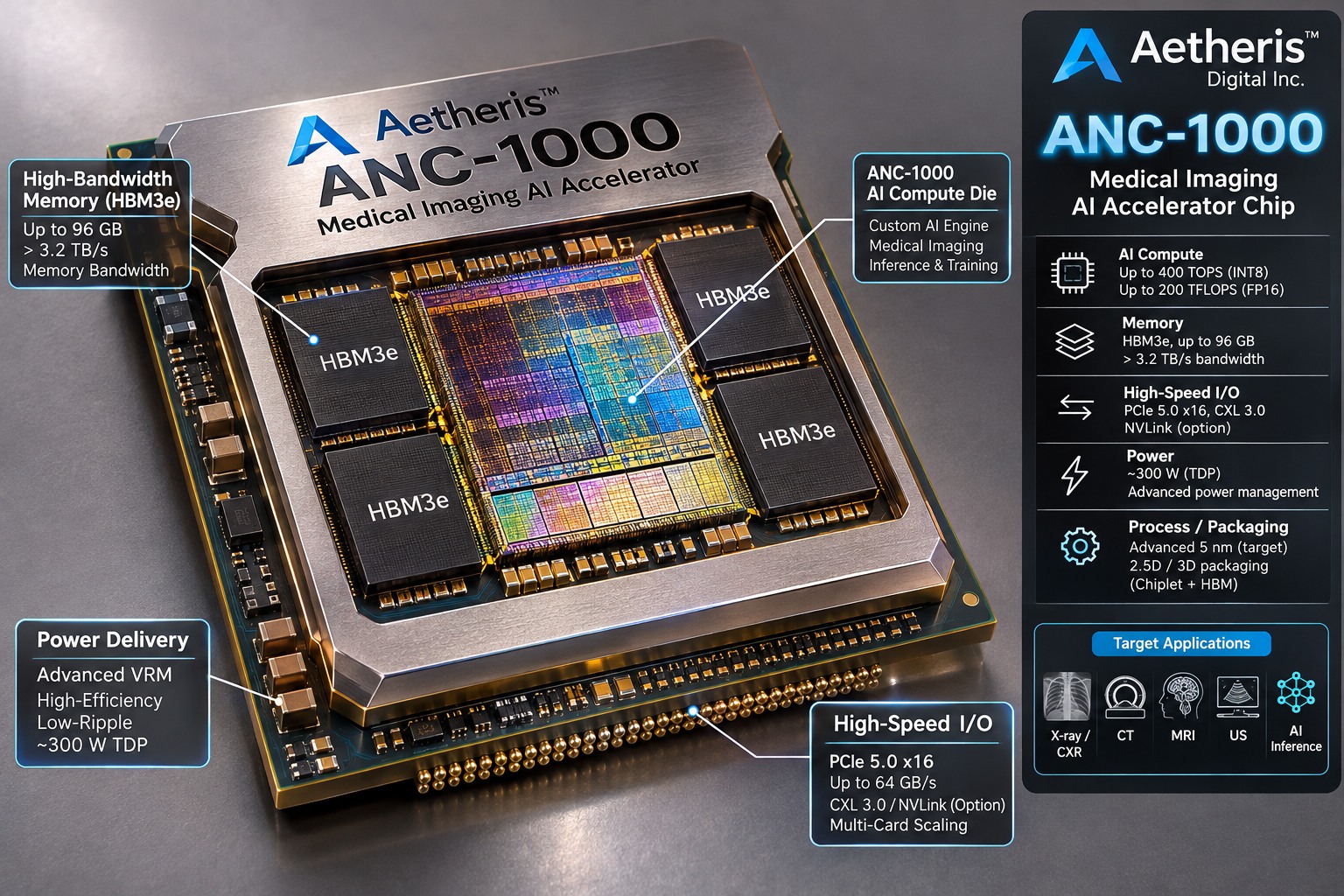
Start with one defined imaging task and a model built for that responsibility.
Investigate a dedicated engine for selected operations, with established GPUs as the development baseline.
Measure numerical behavior and complete-workload performance before making hardware or clinical claims.
Simulate the 16 × 16 INT8 design and complete FPGA synthesis and timing analysis.
Add host interfaces and data movement, then run one bounded research model.
Test real hardware before considering a custom card, silicon or clinical deployment.
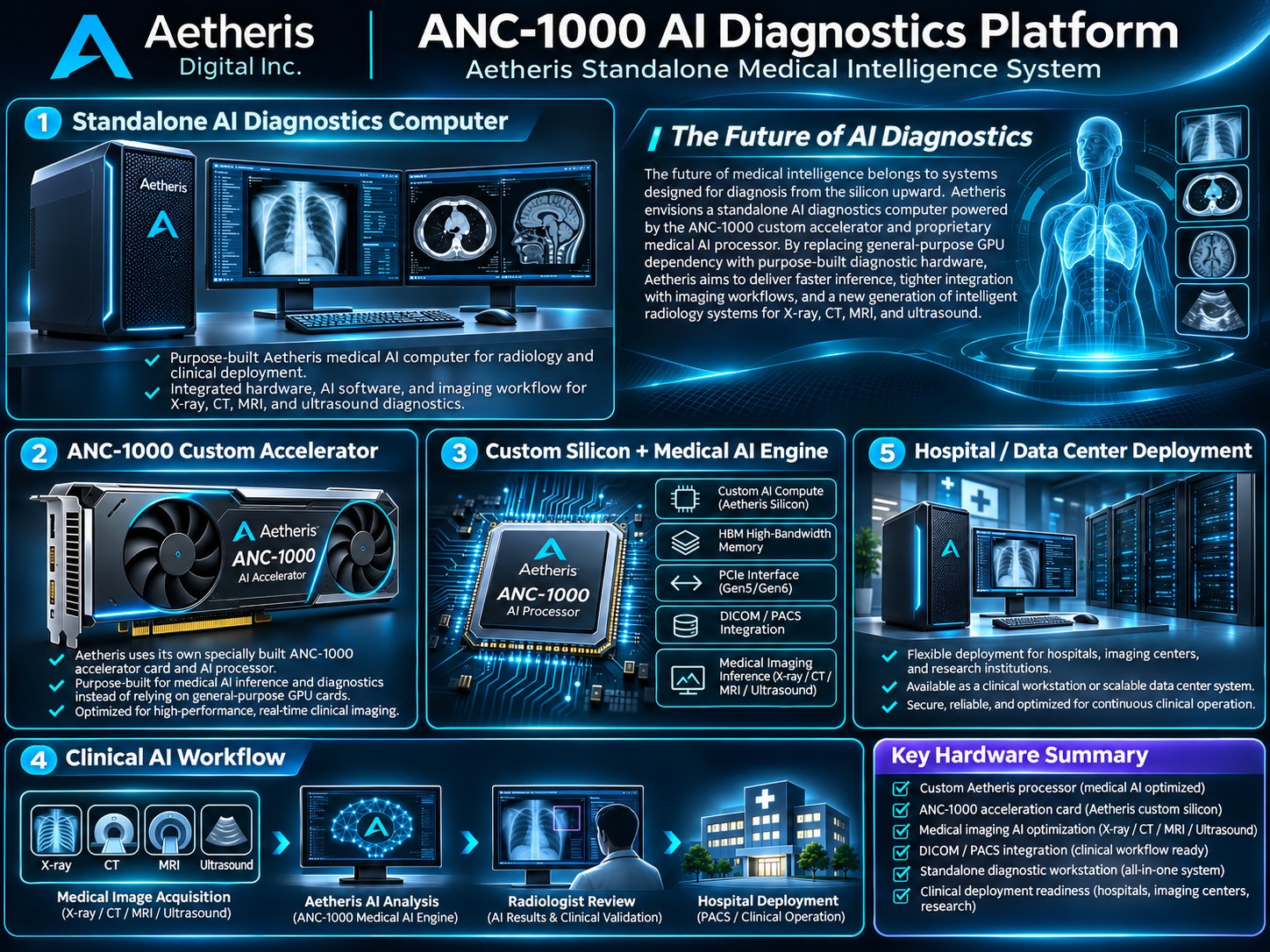
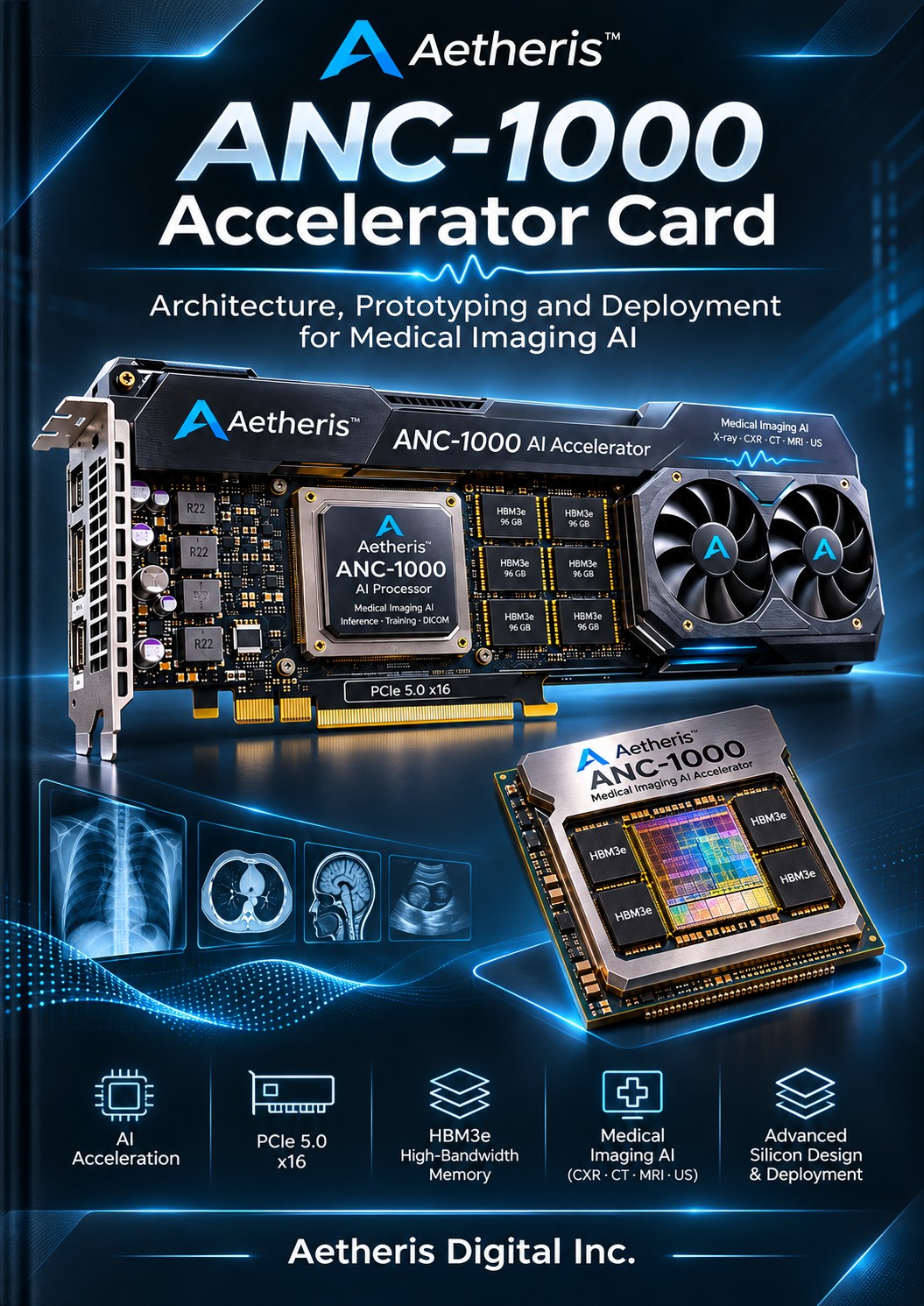
All hardware images are concepts, not photographs of manufactured or clinically validated Aetheris products.
The next advance in radiography AI may come from designing the model, the memory system, the accelerator and the clinical workflow as one system—each shaped around a clearly defined imaging task.
Aetheris envisions a future in which medical imaging software has a computing foundation of its own. The ANC-1000 is the proposed first step: a dedicated AI accelerator intended to execute selected neural-network operations for Aetheris imaging applications. The ambition is to move from adapting every deployment to a broad computing platform toward a system whose hardware and software are developed together.
NVIDIA GPUs remain a strong starting point for model development, training and flexible inference. Modern GPU platforms already include specialized AI capabilities, and optimized inference software can make effective use of them. The ANC-1000 direction is therefore a research question: can a narrower, carefully measured workload benefit from a more focused execution and memory design? Any answer must come from fair benchmarks, not from the appearance of a custom card.
Technical context: NVIDIA’s TensorRT benchmarking documentation describes latency, throughput and end-to-end performance measurement.
The long-term goal is greater control over the inference stack: which operations run, how data moves, which model version is loaded, and how the result returns to the review workspace. Local execution could also reduce dependence on an external inference service where a deployment’s security and operational requirements favor an on-site system. These are proposed benefits to evaluate, rather than capabilities demonstrated by ANC-1000 hardware today.
A useful first system should not promise to interpret every image or diagnose every condition. The Aetheris project discussions instead describe a family of specialist models, starting with a bounded chest X-ray research task and expanding only after each component has been evaluated. A future task might target a specific radiographic finding, a quality-control question, or a well-defined measurement workflow.
In that vision, a diagnosis-specific deployment would pair a selected model with an approved input protocol, documented output meaning, fixed preprocessing rules and versioned accelerator software. The hardware would accelerate the calculations; it would not independently establish a diagnosis. The model, evidence and intended use would define what the system is permitted to claim.
A dedicated card need not be permanently hard-wired to one disease. A programmable accelerator could load a controlled, task-specific model package, while a more specialized design might support a narrower family of operations. The engineering decision is how much specialization delivers useful efficiency without making model updates, verification or maintenance impractical.
Radiologists would remain central to the proposed workflow. A future result should arrive with its study context, model version and review status, giving the clinician a way to inspect the original image and assess whether the output is relevant. A fast answer is useful only when its meaning and limits are understood.
The ANC-1000 concept has three distinct layers. NeuralCore is the proposed compute architecture. The accelerator card would combine that engine with memory, host connectivity, power delivery and cooling. The standalone Aetheris workstation would provide the image archive, DICOM handling, viewer, model runtime and reporting tools surrounding it.
The host would receive an imaging study, prepare model inputs and dispatch supported operations to the accelerator. The card would execute the supported arithmetic and return results to the host application. Image display, access control, audit records, model selection and report preparation would remain software responsibilities rather than being assumed functions of the chip itself.
The earlier project discussions connect this direction to Aetheris 1.0, Aetheris Nova, Lumivra and the proposed LumaCore runtime. The practical integration point would be a documented host API with explicit job submission, data transfer, completion and error handling. The current web application is a separate research workspace; no ANC-1000 hardware connection is claimed here.
Domain-specific acceleration has a genuine research precedent. The original Tensor Processing Unit study examined a custom inference ASIC designed around a defined workload. That work supports investigating specialization, but its historical benchmark results cannot be transferred to a new Aetheris design or used to predict its performance.
Research context: Jouppi and colleagues, In-Datacenter Performance Analysis of a Tensor Processing Unit (2017).
The ANC-1000 v0.2 engineering discussion records a small arithmetic design as the current baseline. It is a source-code starting point for an FPGA prototype, not a finished PCIe card.
Project status is drawn from the existing Aetheris engineering discussions. The source package has not been independently audited for this article. Renderings showing HBM3e capacities, compute rates, process nodes or finished deployment features represent longer-term concepts; they are not measurements of the v0.2 arithmetic design. Proprietary interconnects would require separate feasibility and licensing work.
An inference-first approach keeps the first milestone manageable. Training can continue on established platforms while the custom engine is tested on a selected, already-trained model. Before a model runs on a new numerical implementation, its outputs must be compared with a reference implementation, including the effects of quantization and unsupported operations.
Complete HDL simulation, test signed arithmetic and control behavior, and compare results with the software reference before making speed claims.
Add command registers, AXI interfaces, buffered data movement and host software on a supported development platform. This stage would establish a working prototype before custom board manufacturing.
Select a small imaging research model, implement its supported operations and compare numerical outputs with the original software model.
Evaluate end-to-end latency, sustained throughput, memory movement, power, thermal behavior and failure recovery under equivalent conditions against a well-optimized baseline.
Only after prototype evidence, assess a dedicated PCB, production engineering and the cost and value of an ASIC. Clinical deployment would require its own validation and applicable regulatory pathway.
A future medical AI system must be evaluated for its intended users, images and clinical setting. Hardware acceleration does not itself establish diagnostic accuracy. An efficient implementation could still reproduce a poorly validated model’s errors faster. The development program therefore needs independent data, appropriate reference standards, subgroup evaluation and a clear account of how people will use its results.
The transition toward dedicated hardware must also preserve reproducibility. Model versions, preprocessing, numerical behavior and updates need to remain traceable across the development lifecycle. This is the practical connection between a silicon roadmap and a trustworthy medical workflow.
Development context: the FDA’s Good Machine Learning Practice page points to international lifecycle principles for AI-enabled medical devices.
The Aetheris ambition is a coherent medical-intelligence platform: imaging software that understands the workflow, specialist models with defined responsibilities, and an accelerator engineered around the operations those models need. The ANC-1000 gives that ambition a name and a development path. Its future value will be established through implementation, measurement and clinical evidence—not by replacing one brand of hardware with another.
The v0.2 notes describe a 16 × 16 parallel INT8 multiplication array, 256 signed 32-bit accumulators, a 512-byte scratchpad and start / busy / ready / done controls. They also describe SystemVerilog and Python reference scenarios.
HDL simulation, FPGA synthesis, timing, host connectivity and physical-board testing remain outstanding. The source package has not been independently audited for this page. No finished PCIe accelerator, measured speed advantage or clinical approval is claimed.